
Why You Can't Grow Peppermint From Seed
There's a packet of peppermint seeds on a rack in a garden center right now. Probably several. They're inexpensive, the picture on the front looks great, and they will not grow peppermint.
Not because they're old, or badly stored, or because you'll do something wrong.
Peppermint cannot produce seed at all.
Peppermint is a hybrid, and it's sterile
Mentha × piperita — the × is the giveaway — is a cross between watermint (Mentha aquatica) and spearmint (Mentha spicata). It arose naturally, was first documented near Mitcham, England in the 1690s, and turned out to have far more menthol than either parent. That's why it took over the world's tea, toothpaste, and confectionery.
It's also sterile. The chromosome mismatch between its two parent species means peppermint doesn't produce viable seed. Every peppermint plant in existence is descended from that original hybrid by cuttings and division — an unbroken chain of clones running back more than three hundred years.
The peppermint in your tea is, quite literally, a piece of the same plant that was growing in Mitcham when Queen Anne was on the throne.
So what's in the packet?
Something. Just not peppermint.
What's typically sold as peppermint seed is a coarse form of spearmint — and by the assessment of growers who've actually germinated it, a fairly rank-smelling one with little value as a kitchen herb. It'll come up. It'll be green. It'll be a mint of some description. It won't be the plant on the label, and you probably won't want it in your tea.
This isn't usually deliberate fraud. It's a labeling convention that has drifted loose from the botany, and it persists because seed is cheap to sell and most buyers don't know enough to complain.
The deeper problem: named varieties are clones
Even setting sterility aside, there's a second reason seed doesn't work for mint — and it applies to every named variety, not just peppermint.
Chocolate mint isn't a species. It's an individual.
Somebody, at some point, noticed one particular mint plant that smelled like chocolate, and every chocolate mint since has been propagated from cuttings of that plant. It's a clone. The chocolate character comes from one specific ratio of menthol to menthyl acetate in that one genetic individual.
Seed, if it were produced, would be a genetic recombination — a shuffle of the parents' genes. It wouldn't be chocolate mint. It would be a seedling of chocolate mint, which is a different thing entirely, the way a child is not a copy of a parent.
This is the same reason you can't grow a Honeycrisp apple from a Honeycrisp seed. Plant that seed and you get an apple tree, one nobody has ever tasted before, and it almost certainly won't be Honeycrisp. Every Honeycrisp on earth is grafted wood from one original tree in Minnesota.
Chocolate mint, pineapple mint, banana mint, Kentucky Colonel, basil mint — all clones. All propagated by cuttings and division, because that's the only method that preserves the thing that makes them worth growing.
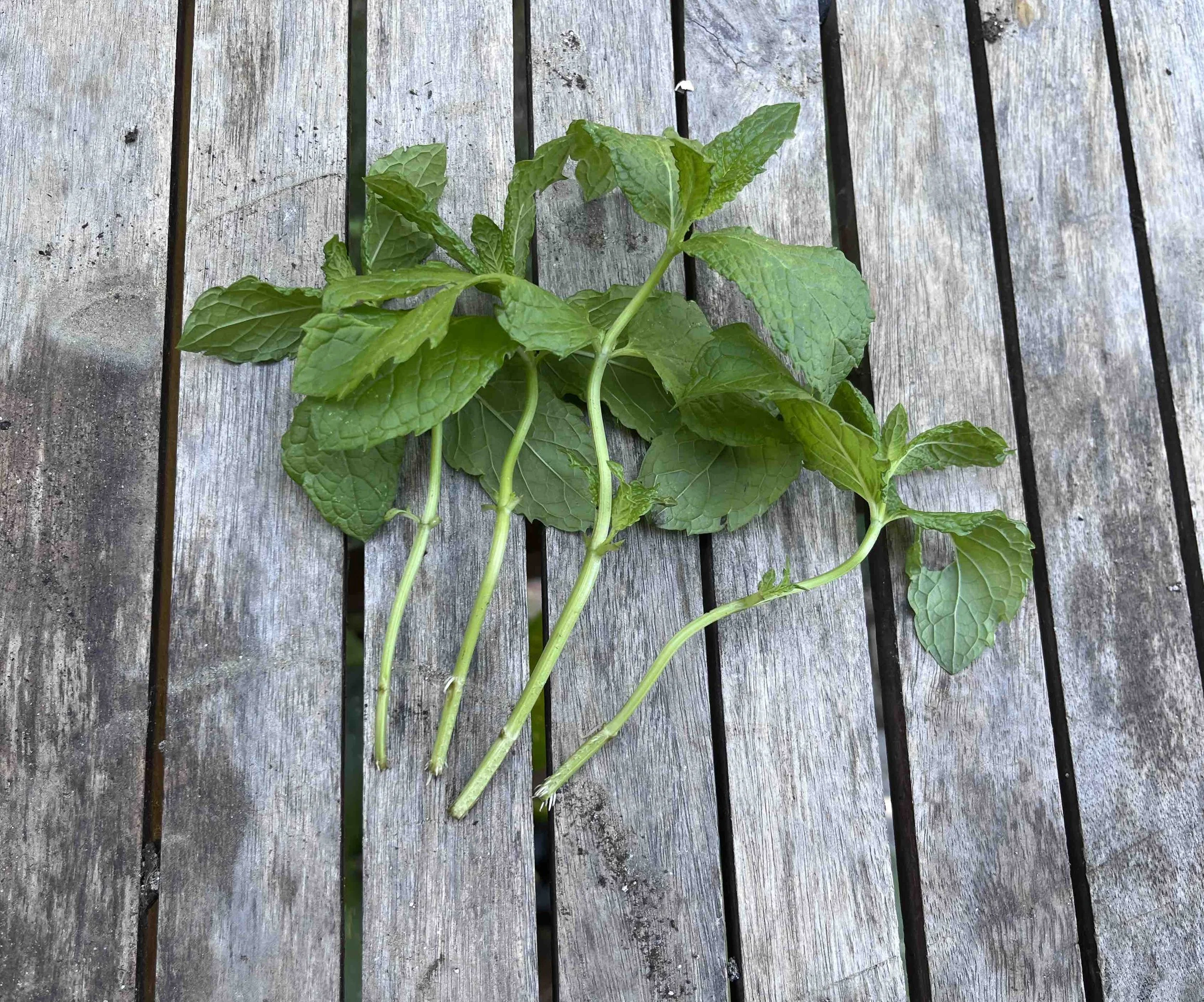
Mint stems easily root in water - the photo above shows small roots extending from these cuttings after about a week.
Mint makes this worse than most plants
Mentha is famously promiscuous. The genus hybridizes so freely — in gardens, in the wild, between species that supposedly shouldn't cross — that new mints appear spontaneously and constantly. Spearmint itself is a hybrid. Peppermint is a hybrid of a hybrid.
That's wonderful for the diversity of the genus and terrible for anyone hoping seed will reproduce a specific plant. Mint seed is a lottery ticket. Sometimes an interesting one — a fair number of named varieties began as somebody's chance seedling — but a lottery ticket all the same.
One honest complication
Sterility in mint isn't absolute across the board. It's tied to chromosome number, and polyploidy can restore fertility — the diploid form of 'Black Mitcham' peppermint is sterile, while polyploid forms can set seed. Some Mentha species, particularly the ones that aren't hybrids, produce viable seed perfectly well.
So "no mint can be grown from seed" would be too strong. The accurate version is that the mints worth growing — the named cultivars with distinct flavors — are essentially all sterile hybrids or clonal selections, and none of them come true from seed.
If you buy generic "mint" seed you'll get a mint. Just not a particular one, and not reliably the same thing twice.
What to do instead
Mint is one of the easiest plants on earth to propagate vegetatively, which is why nobody who's serious about it bothers with seed.
Take a cutting. Snip four to six inches of stem below a leaf node, strip the lower leaves, and put it in a glass of water on a windowsill. Most mints root within one to two weeks. This works with a sprig from a friend's garden, and it works with the mint in a grocery store clamshell if it's fresh enough.
Divide a clump. An established mint plant is a mat of rhizomes. Dig a piece with roots attached, plant it elsewhere, water it. That's the whole technique.
Buy a rooted plant. Bare root or potted, from someone who knows which variety it actually is.
All three give you the exact plant you wanted, with the exact flavor, in a fraction of the time seed would take. And all three are how every mint in commerce has moved for centuries.
The short version
If a seed packet promises you peppermint, chocolate mint, or any other named variety, the botany says otherwise. Peppermint makes no seed. Named cultivars are clones that don't come true. What's in the packet is a generic mint at best.
Mint has been passed hand to hand as living cuttings since before anyone thought to put it in an envelope. There's a reason the method stuck.
We grow 21 varieties in our field in Brattleboro, Vermont — all propagated the old way, by division and cuttings, and shipped bare root. You get the actual variety, because it's a piece of the actual plant.
