
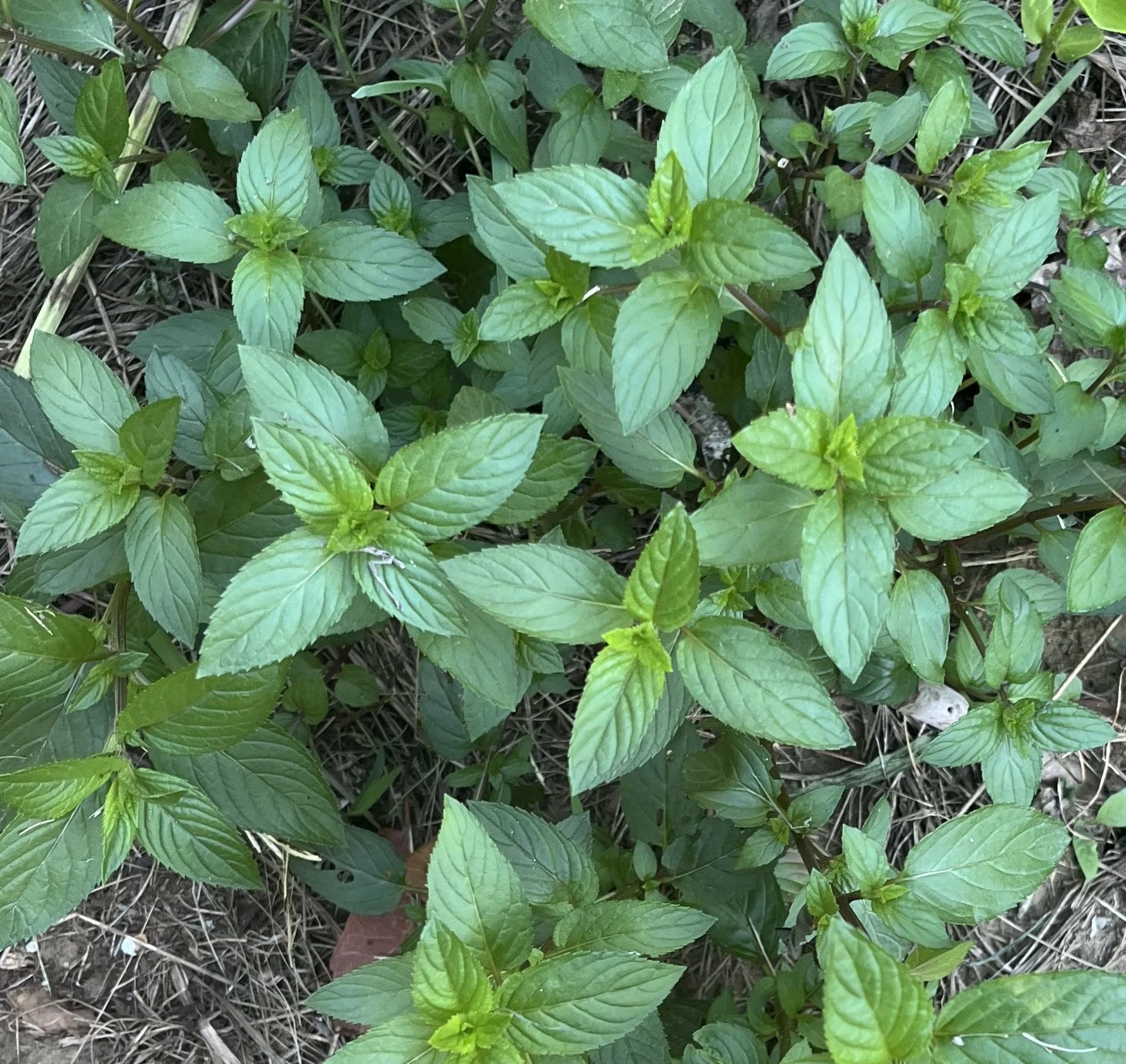
Chocolate Mint like this has a wonderful rich mint smell.
Count the mint you've already touched today.
Toothpaste, almost certainly. Mouthwash, if you use it. The floss is probably mint-coated. Then gum, breath mints, lozenges, the candy cane at Christmas, the tea, the shampoo that tingles, the muscle rub, the lip balm, the sweet at the bottom of the restaurant bill. Root beer, if you drink it.
No other plant has this reach. Vanilla is beloved but confined to dessert. Citrus does well in cleaning products. Lavender owns soap and not much else. Mint took the entire human mouth, plus a decent share of everything else.
Here's the strange part.
Mint doesn't clean anything
Menthol has some mild antibacterial activity, but that's not why it's in your toothpaste, and it contributes essentially nothing to getting your teeth clean. The cleaning is done by the abrasive and the fluoride. You could remove the mint entirely and the toothpaste would work exactly as well.
So why is it there?
Because of an advertising campaign from the 1910s
In the early twentieth century, most Americans didn't brush their teeth. Toothpaste existed, but it was a minor product with no real habit behind it.
Pepsodent's inventor added a few things to his formula that other toothpastes didn't have — citric acid, and a dose of mint oil. These are irritants. They make your tongue and gums tingle. That tingle serves no cleaning purpose whatsoever.
Then Claude Hopkins, one of the most effective advertising men who ever lived, took on the account. And he made a decision that shaped the next hundred years of a global industry: he told people the tingle was the proof. That cool, sharp feeling was how you knew it was working.
It wasn't true. But it was the first time brushing your teeth produced an immediate, unmistakable sensation — a reward you could feel the moment you did it, every single time.
Within a few years, 60% of American homes had a tube of Pepsodent. Competitors noticed, added mint to their own formulas, and consumers — now trained — came to prefer it. A century later, mint is the default flavour of oral hygiene across most of the world, because of a tingle that was added to sell a product.
And because menthol lies to your nervous system
The advertising only worked because menthol had something remarkable to offer.
Menthol does not cool anything. It doesn't lower the temperature of your mouth by a fraction of a degree. What it does is bind to TRPM8, a receptor in your nerve endings whose actual job is detecting cold.
When the temperature drops, TRPM8 fires and your brain reports cold. Menthol binds to that same receptor and triggers exactly the same signal. Your brain has no way to tell the difference. It reports cold because the cold sensor said cold — and the cold sensor was fooled.
This is why mint feels like something rather than merely tasting like something. It's the only common flavour that produces a physical sensation, and that sensation happens to be one humans associate with freshness, cleanliness, and water.
Capsaicin in chilli does the reverse, binding a heat receptor to produce burning without heat. Mint and chilli are the same trick pointed in opposite directions.
How mint flavour is actually made
The dominant method hasn't changed much in a century: steam distillation.
Harvested mint — usually field-wilted first to reduce water content — goes into a large sealed vessel. Pressurised steam is forced through the plant material. The steam carries the volatile oils out of the leaf, and the mixture is condensed back into liquid. Oil and water separate, the oil is drawn off, and what you have is peppermint essential oil.
That oil is roughly 30 to 50% menthol, alongside menthone, menthyl acetate, and eucalyptol. Those proportions are what make one peppermint taste different from another.
To get pure menthol, the oil is chilled and the menthol crystallises out — the same principle as rock candy forming in sugar syrup. Those white crystals are what end up in your lozenge.
It takes a startling amount of plant. Mint is roughly 85–90% water, and essential oil is a fraction of what's left.
Most of the mint you meet never saw a mint plant
Here's where it gets genuinely odd.
Synthetic menthol is chemically identical to the natural kind — the same molecule, atom for atom — but it's built in a factory from starting materials like thymol, m-cresol, or citral. No mint is involved at any point.
And by some measures it's the better product. Synthetic menthol has a purer and more consistent flavour and odour profile, because it lacks the trace compounds that come along with a natural extraction. A crop varies by season, soil, and weather. A chemical process doesn't.
For an industry making billions of identical toothpaste tubes, consistency wins.
So the flavour that conquered the world is now largely manufactured — and the plant it was named after has become, for most commercial purposes, optional.
There isn't one mint flavour. There are three.
What we lump together as "mint" is actually three unrelated compounds from three different plants:
They don't taste alike, they aren't chemically related, and only two of them are true mints. Wintergreen isn't a mint at all — Gaultheria is in the same family as blueberries, and methyl salicylate is chemically a cousin of aspirin.
Which brings us to root beer. That distinctive flavour is traditionally sassafras and wintergreen — so the "minty" note in a craft root beer is usually methyl salicylate, from a plant more closely related to a rhododendron than to anything in a mojito.
The scale of it
American peppermint is grown mainly in Oregon, Washington and Idaho, and it's a real agricultural crop — not a herb garden curiosity.
It's also shrinking. US peppermint oil production runs around 3.35 million pounds, down from 6.27 million in 2013. Harvested acreage fell from roughly 76,900 acres in 2012 to 34,000 in 2022 — less than half in a decade.
Synthetic menthol is part of that story. So is Verticillium wilt, a soil fungus that killed the Midwestern mint industry in the 1950s and followed the crop west.
The plant is in retreat. The flavour is everywhere.
What this means for a mint plant on your windowsill
Nothing, really. But it's worth knowing what you have.
The mint in your toothpaste is a molecule, optimised for consistency, probably made from thymol. The mint on your windowsill is a plant whose scent shifts with the weather, the time of day, and how recently you cut it — and which tastes different in June than in September.
That variability is exactly what industry engineered out. It's also the entire reason chocolate mint and banana mint and basil mint exist at all: hundreds of years of people noticing that this one smells different from that one, and keeping it.
You can't buy that in a tube.
We grow 21 varieties in our field in Brattleboro, Vermont. Every one of them smells like something a factory couldn't be bothered to reproduce.
